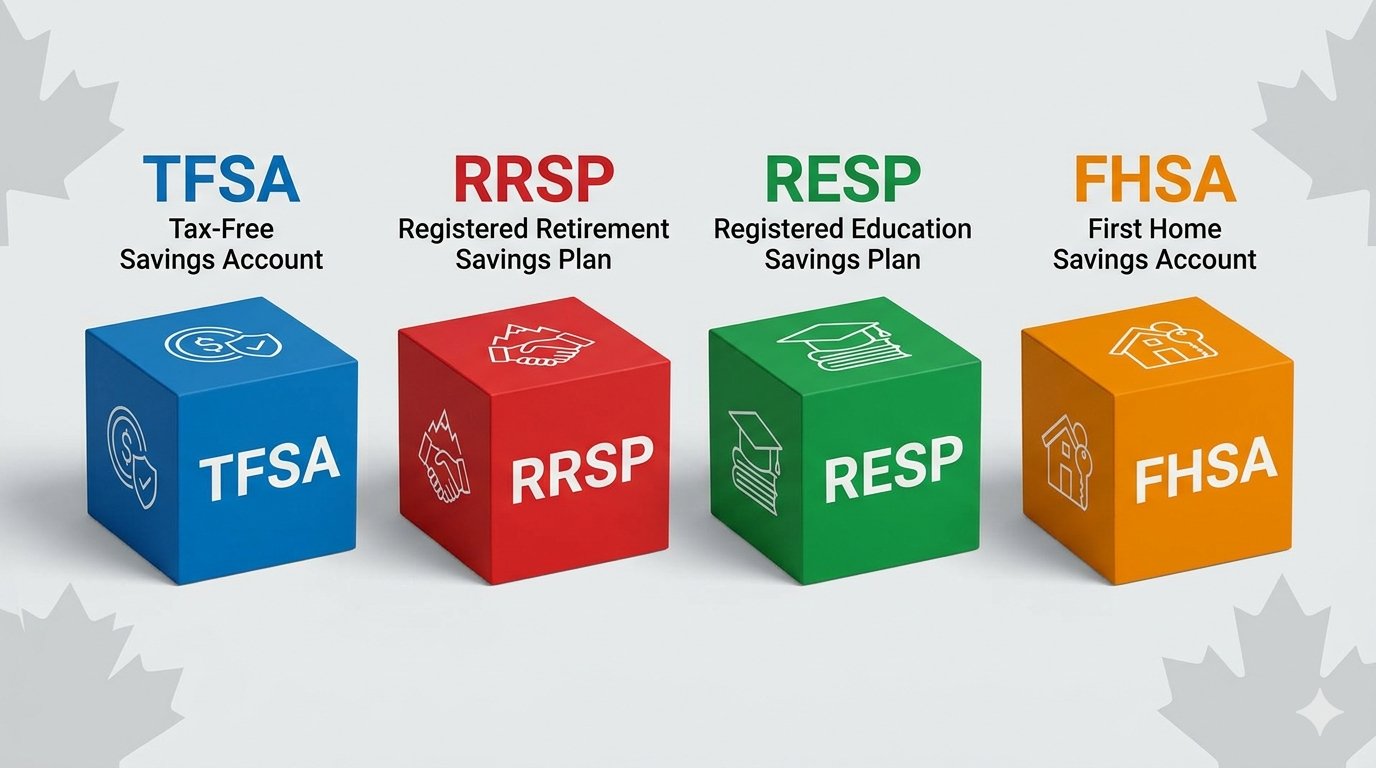
I am sure that most have heard of TFSA, RRSP, and RESP, FHSA however, a recent article by the National post indicated that many are not aware of how these accounts work. As a result, are not taking advantage of these saving vehicles.
TFSA
I would urge you to set up an emergency fund, before considering these vehicles. A TFSA account can be used as an emergency fund, but there are reasons as to why this may not be the best option. An emergency fund, should ideally cover two to three months of expenses, in the event you are laid off, are sick, etc. This post is designed to be a primer, and should only be used as such.
The tax free savings account, is designed for you to invest after tax dollars. In return, any dividends, interest, and capital gains that are earned within this account are not taxed. You can contribute up to a maximum amount per year, even if you do not file tax returns. The years that apply to you, are any years in which you were over the age of 18 and a resident of Canada
The contribution limits per year are:
2009 through 2012 – $5,000 per year
2013-2014 – $5,500 per year
2015 – $10,000
2016-2018 $5,500
2019-2022 $6,000
2023 – $6,500
2024 – 2026 $7,000
If you were over the age of 18 and a resident of Canada for all of the years above, and did not make any contributions into a TFSA account, then your maximum contribution limit is $109,000.
There are a few things that you should be aware of:
- You can withdraw money at any time, however, your contribution limit does not return until the following year. For instance if you have made the maximum contributions up to 2026, and you withdraw $10,000 in 2026, you cannot put it back, until 2027
- You cannot use a TFSA account, if you are an active trader. The CRA is clamping down, on those with higher than expected returns
RRSP
Unlike a TFSA account, an RRSP account is based on the income you report on your tax return. The contribution limit is 18% of your net income, of the previous year to a maximum of $33,810. Also, unlike a TFSA account the contributions are made using pre-tax dollars. Interest, dividends and capital gains are not taxed within the RRSP account. However, any amount that you withdraw is taxed as income.
Your tax return notice of assessment shows you the maximum deduction limit, based on the income you have earned and contributions made to date. You can also view it by logging in to your CRA My Account.
An RRSP account is designed as a long term savings account. It should not be used if you foresee a need for this money.
Here’s a look as to why you get a tax refund when you contribute to an RRSP account, and how the refund works.
For example, you are employed full time and you are paid $65,000 per year. At the same time you contribute $5,000 to your RRSP account, from your net pay, and you live in Ontario. Your employer would have deducted around $12,000 over the year from your paycheques. When you complete your tax return, you will receive a refund of roughly $1,600. This is due to the fact, that the highest tax bracket that you are in is 32%.
As RRSP contributions are deducted from your income, your tax refund can be calculated by using your highest tax bracket.
An RRSP account is essentially a tax deferral account.
What this means is that while you get a tax refund now, any amount you withdraw is taxed as income. This is one of the pitfalls, in investing into an RRSP account without having other savings accounts.
For example, you earn $65,000 per year, and have $60,000 in an RRSP account with no other savings accounts. You have an emergency that requires you to pull out $20,000 from your RRSP. Here are the consequences. For starters the bank will deduct a minimum of 10% as tax withholdings from your withdrawal. You will get a maximum of $18,000 now. Assuming that you worked the entire year, your income is now $85,000, and your total tax is roughly $18,000. Assuming your company withheld $12,000 per above, and the bank withheld $2,000, you will now owe roughly $4,000 on your tax return. This means that while you thought you will have $20,000, the amount that stays in your pocket is only $14,000.
RESP
An RESP account is designed as a vehicle to save for your children’s education. The contributions are not tax deductible, and the plan is designed for the benefit of your children only. Contributions can be made for children up to the age of 31. The funds within the plan must be fully utilized within 35 years of the plan being set up.
There is a maximum contribution to the plan per child of $50,000, however, the government will match 20% of the first $2,500 contributed per year, to a maximum of $7,200 per beneficiary. The government will do so up to the age of 18.
If you were to contribute the maximum per child the $7,200 translates to a 14.4% return on your money, not including the income generated inside the RESP.
The other benefit of an RESP account is that any income earned within the RESP, is taxed on your child’s tax return, where there will be very little or no tax when they withdraw it.
If you withdraw the contributions that you have made, there won’t be any tax on them, as the contributions were made using after tax dollars. However, withdrawing the government grants, and income earned, will be taxable to the beneficiary.
There are rules regarding how much can be withdrawn and when, which are beyond the scope of this post.
FHSA
The First Home Savings Account (FHSA) is a registered plan for first-time home buyers. It combines the tax-deductibility of an RRSP with the tax-free withdrawals of a TFSA. You can contribute up to $8,000 annually, with a lifetime limit of $40,000. Unused contribution room can be carried forward up to a maximum of $8,000 for the following year.
Contributions are tax-deductible (reducing your taxable income), and qualifying withdrawals to buy a home are completely tax-free. An FHSA must be closed after 15 years, or by the end of the year you turn 71, or in the year following your first qualifying home purchase—whichever comes first. You can transfer the funds to an RRSP or Registered Retirement Income Fund (RRIF) on a tax-deferred basis.
As always if you have any questions or need help with any of your tax or accounting needs please contact us.