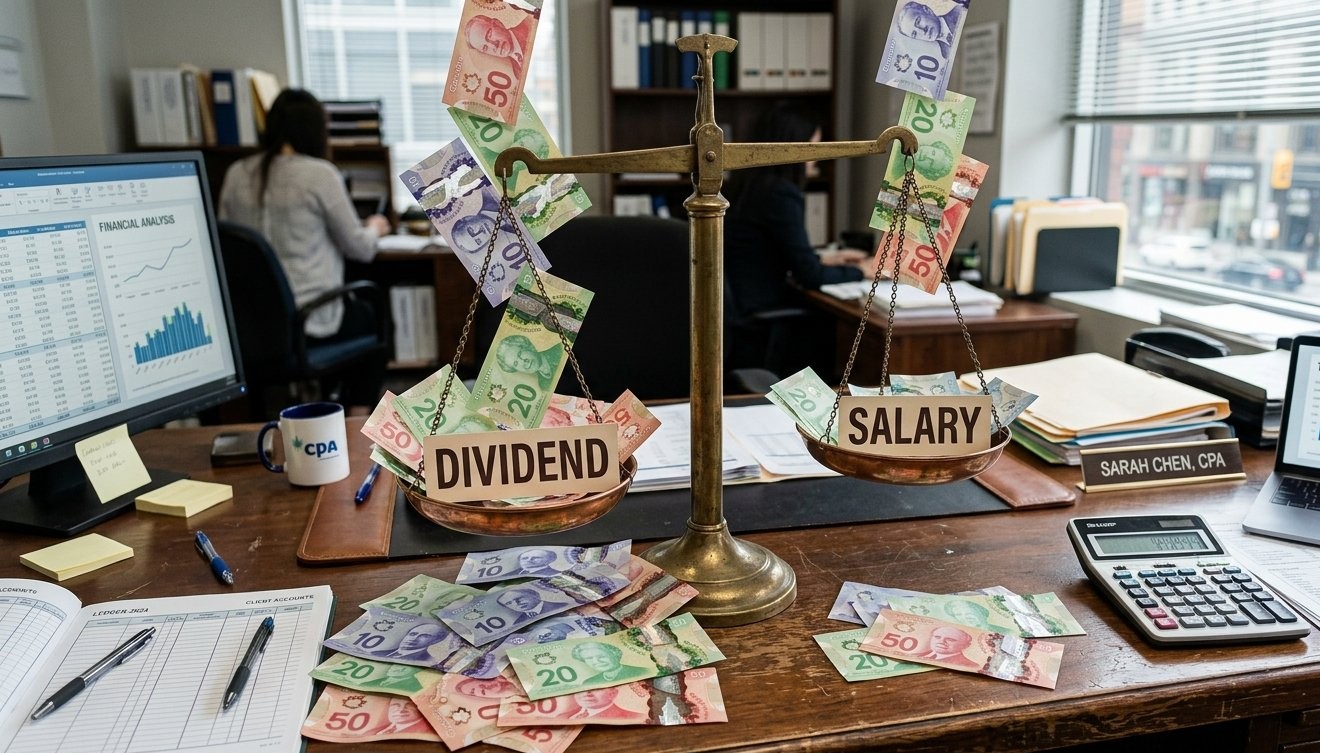
This post offers a brief overview of what to consider when choosing between dividends and salary:
This post, is based on the following assumptions, and deals with the tax rates for 2025:
- The corporation qualifies as a Canadian Controlled Private Corporation.
- The corporation operates in Ontario, and the shareholder is a resident of Ontario for personal tax
- Corporate profits before tax are $124,430.10 to account for CPP
There are only 2 mechanisms, through which, shareholders of a corporation can pay themselves:
- Salary – an expense to the corporation
- Dividends – a distribution of after-tax corporate profits
For simplicity, I will only use examples where the corporation pays tax at the small business rate (“SBR”) of 12.2% (ineligible dividends), and the general rate (“GRIP”) of 26.5% (eligible dividends), and I will not illustrate combinations of dividends with salary.
Salary
Assuming, that the shareholder of a corporation, will choose to pay themselves $120,000 from the profits of a corporation as a salary, the following will be the tax paid by the corporation and shareholder:
| Corporate profit | $ 124,430 | |
| Corporate CPP | $ 4,430 | |
| Salary | $ 120,000 | |
| Corporate taxable income | $ – | |
| Corporate tax | $ – | |
| Personal CPP | $ 4,430 | |
| Personal tax | $ 27,843 | |
| Total personal tax | $ 32,273 | |
| After tax income | $ 87,727 |
Nulla in tristique nibh. Phasellus porttitor leo id risus cursus. Aliquam tincidunt rutrum ante, eu vestibulum elit phare.

Dividend
Assuming instead that the shareholder of a corporation, will choose to pay themselves the corporate profits as a dividend, the following will be the tax paid by the corporation and shareholder:
| SBR | GRIP | |||
| Corporate profit | $ 124,430 | $ 124,430 | ||
| Corporate CPP | $ – | $ – | ||
| Salary | $ – | $ – | ||
| Corporate taxable income | $ 124,430 | $ 124,430 | ||
| Corporate tax | 12.20% | $ 15,180 | 26.50% | $ 32,974 |
| Dividends for distribution | $ 109,250 | $ 91,456 | ||
| Personal CPP | $ – | $ – | ||
| Personal tax | $ 16,623 | $ 2,516 | ||
| After tax income | $ 92,627 | $ 88,941 |
Based on the above table, the shareholder will receive a dividend of $109,250, or a dividend of $91,456, or a salary of $120,000
As you can see from the tables above, the difference across all 3 is $4,900, with the best appearing option being ineligible dividends, or those paid from corporate profits taxed at the small business rate, and the worst looking option being getting paid a salary.
Seeing that as a shareholder you are indifferent as to how you get paid, as long as you get paid, looking at the above tables, I am assuming that you are speed dialing your accountant, and asking why they isn’t paying you through dividends.
You should probably put the phone down, and read this last little bit, before you rush to conclusions.
There is one key ingredient missing from the above tables. They overlook your retirement planning. If you choose to pay yourself through dividends, you will not be paying into the CPP, and as such, you will not receive CPP, when you choose to retire. While the difference between the ineligible dividend and salary amounts to $4,900, you have made a personal contribution to the CPP of $4,430, in addition to the corporation’s contribution of the same amount. Additionally, RRSP contribution room, is based on earned income, meaning that if you only have dividend income you will not be able to contribute to an RRSP plan.
Now, that you are ready to take a more holistic approach, it is time to contact your accountant, and come up with the best plan for you, based on your individual circumstances, goals, and needs.
As a side tip, don’t forget the paperwork. If you pay yourself by way of salary, you will have to issue a T4 by the end of February of the following year. If you choose to pay yourself by way of dividend, you will have to issue a T5 by the end of February of the following year, along with a corporate resolution.
Don’t have an accountant, contact us. We will be delighted to create the best strategy for your needs.
This post provides general information on various tax issues and other matters. The information is not intended to constitute professional advice and may not be appropriate for a specific individual or fact situation. It is written by the author solely in their personal capacity and cannot be attributed to the accounting firm with which they are affiliated. It is not intended to constitute professional advice, and neither the author nor the firm with which the author is associated shall accept any liability in respect of any reliance on the information contained herein. Readers should always consult with their professional advisors in respect of their particular situation.