No matter what economic or business conditions exist, cash is always the key to a successful enterprise. This is the reason that cash is king. Many have difficulties determining the cash generated by their business, and when it comes to forecasting future cashflows.
Cashflows are made up of many components, each of which, requires it’s on train of thought. I will post each component separately, to be able to devote the attention required to each.
This first post, will aim to explain the fundamentals of the cashflow statement, that forms a part of a small to medium sized company’s financial statements, along with how to analyze it. As such, it will not include items found on a large public company’s cashflow statement.
Three Components of Statement of Cashflows Overview
1) Operating activities – these are deemed to be income and expenses generated as part of operating the business. In the context of an individual, this is the equivalent of income earned from employment and/or self employment, less expenses such as utilities, property taxes, groceries, clothing, and rent expense if one does not own their own home.
2) Investing activities – these are costs associated with buying items that will allow the business to continue operating. For a consulting business this section will likely contain the purchase of computers, and software (but not yearly licences). For a manufacturing business is will contain machinery and equipment. In household terms, this section would include a car, home, and/or cottage, and saving plans such as RRSPs.
3) Financing activities – this section contains long term borrowings and repayment of the debt, issuance and redemption of shares. In household terms, this section will include mortgage and car loan repayments and the like.
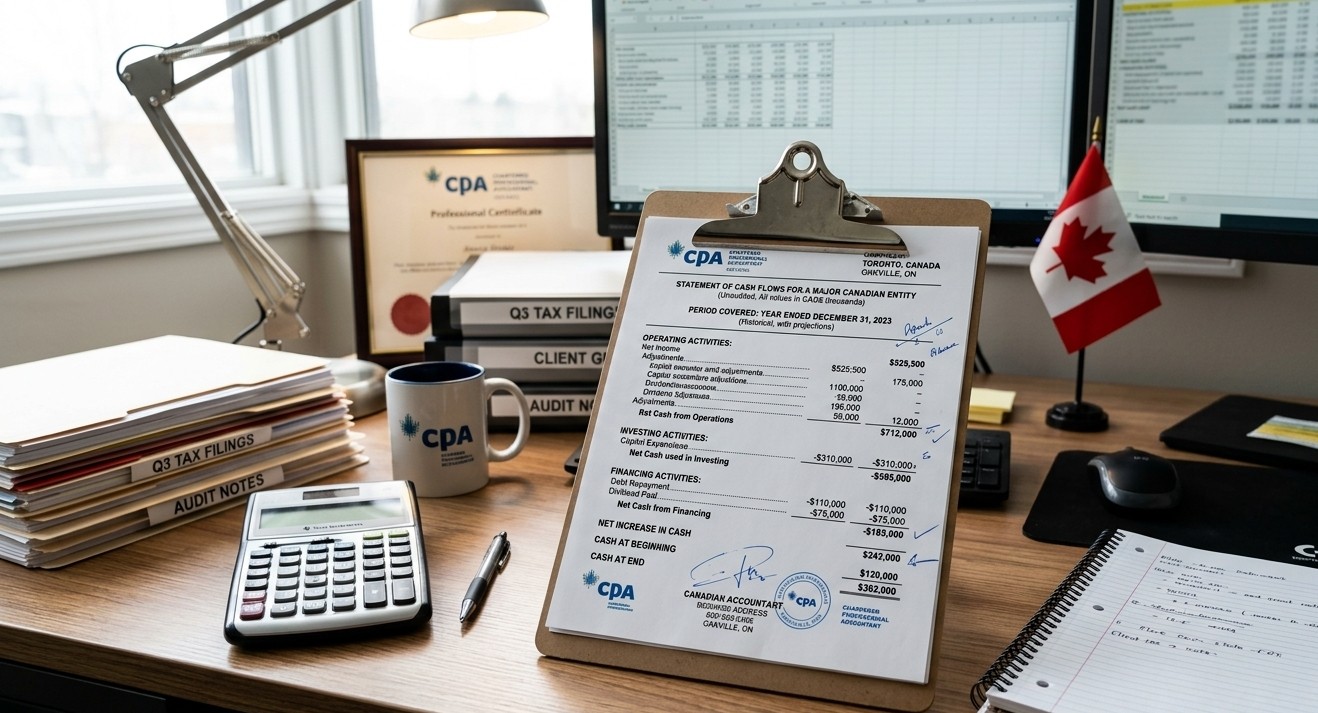
What is the purpose of the cashflow statement, and why should you care?
If you remove the statement of cashflows from the financial statements, you will be left with an income statement and a balance sheet. The income statement will indicate your profit for the period that it covers, while the balance sheet will show you your assets and liabilities on a specific date.
Let’s say you started the business by injecting $1 million into your business, and taking out loans for another $1 million, and that you used $1.5 million of the cash to purchase equipment for your business in your first year. Let’s assume that because it’s your first year of operations, you have to pay all your suppliers when you order items, to build up credit, leaving you with no payables at the end of the year. For simplicity let’s also assume that you have no depreciation expense, and that not all your customers pay you on delivery, because they are not sure they will be able to sell your product, leaving you with $1 million to collect after the end of the year.
Let’s make a further assumption that, you will have items that are unsold at the end of the year totalling $200,000, and that you have repaid your own loan and the bank loan over the course of the year. For this situation to occur your business’ profit for the year is $2.2 million, and will leave you with a negative cash balance of $500,000 (assuming you have a line of credit that you can draw on).
Your cashflow statement
It’s now year end and you are looking at your balance sheet and income statement. You made $2.2 million in your first year, but you also owe $500,000 of cash. Is there reason for concern?
This is where the cashflow statement comes in handy. Your operating section will look as follows:
Net income $2,200,000
Increase in receivables (1,000,000)
Increase in inventory (200,000)
Cashflow from operating activities $1,000,000
Using the above, you can easily see, that even though you had to pay your suppliers in full, and that that you have left over items for sale, and that some of your clients chose not to pay you until your items sold, you managed to bring in $1 million of cash. So where did the cash go?
For that we will go to the investing section of the statement. The investment section will look as follows:
Purchase of equipment $(1,500,000)
Adding the two sections together and your beginning cash of $0 gives you your cash balance at year end of $(500,000)
Should you be stressed?
The question now becomes, how often do you have to buy equipment and how much will it cost? If you do not need to buy any equipment for the next 5 years, and nothing changes in terms of your operations, than you will generate $2.2 million of cash in each of the following 4 years. Why $2.2 million and not the $1 million, you ask? Because of the assumption made that your receivables will be at $1 million each year going forward, and that your inventory will always be at $200,000 at each year end. Below are the numbers to show the cashflow statement at the end of year 2, which will be same until year 6. The cashflow will change in year 7 when you buy more equipment.
Net income $2,200,000
Change in receivables $0
Change in inventory $0
Cash from operating activities $2,200,000
Add beginning cash $(500,000)
Cash balance at end of year 2 $1,700,000
Your investment section and financing section will both be $0.
The next post will use the same example with a different set of assumptions. It will show that having positive net income will not necessarily translate to positive cash.
Need help analyzing your current situation or looking to discuss any of your accounting or tax needs, then contact us.
This provides general information. The information is not intended to constitute professional advice and may not be appropriate for a specific individual or fact situation. It is written by the author solely in their personal capacity and cannot be attributed to the accounting firm with which they are affiliated. It is not intended to constitute professional advice, and neither the author nor the firm with which the author is associated shall accept any liability in respect of any reliance on the information contained herein. Readers should always consult with their professional advisors in respect of their particular situation.